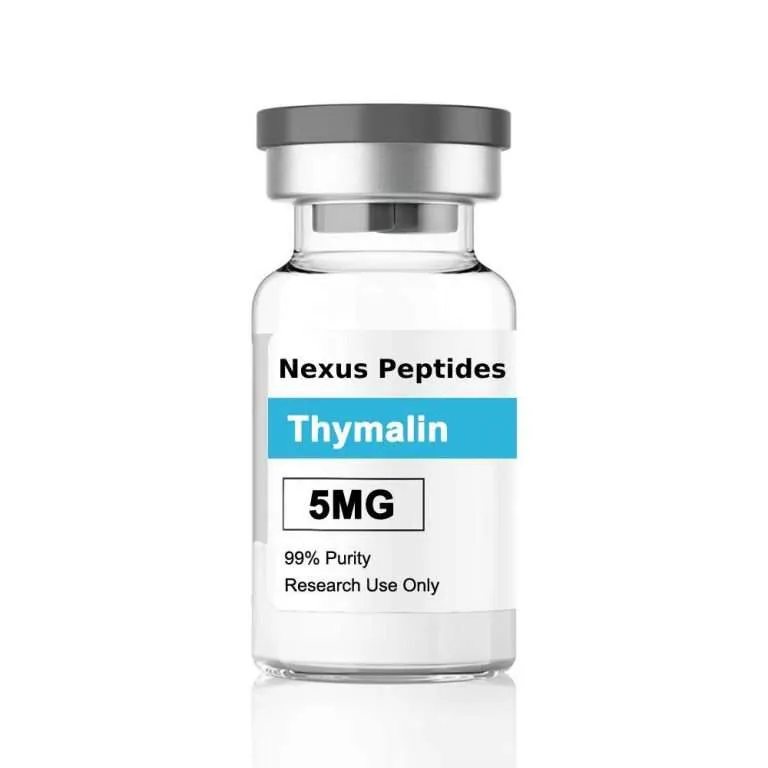
Buy Thymalin: 5-10mg*10 vials
Price range: $120.00 through $190.00
Thymalin 5–10mg × 10 vials for qualified research and laboratory applications involving thymic peptide biology, immune research, aging biology, cellular signaling, and neuroendocrine research.
Description
Buy Thymalin Peptide 5–10mg
Thymalin is a name associated with research into thymic peptides and biological regulation, particularly research involving immune function, aging biology, cellular signaling, and interactions between the immune and neuroendocrine systems.
Our Thymalin 5–10mg × 10 vials product is intended for qualified research and laboratory applications. It may be relevant to researchers investigating thymic peptide biology, immune-related signaling, cellular processes, aging-associated changes, and other experimental areas involving peptide molecules.
Thymalin belongs to a broader area of scientific research surrounding peptides originating from or associated with the thymus. This field has been investigated for decades, with researchers examining how thymic peptides may interact with immune cells and neuroendocrine pathways.
What Is Thymalin?
Thymalin is commonly discussed as a thymic peptide preparation or bioregulator in the research literature.
It is important to distinguish Thymalin from thymulin, which is a specific zinc-dependent nonapeptide produced by thymic epithelial cells. Thymulin has been extensively characterized and studied in connection with T-cell differentiation, immunomodulation, and neuroendocrine signaling.
Because the terms can sometimes be used inconsistently in commercial and online discussions, researchers should pay close attention to the exact identity, composition, characterization, and documentation of any material labeled as Thymalin.
This is particularly important when comparing research products from different suppliers.
Thymalin and Thymic Peptide Research
The thymus is an important organ in immune-system biology and plays a central role in the development and maturation of T lymphocytes.
Researchers have therefore investigated thymic peptides for their potential relationships with:
- Immune-cell development
- Immune regulation
- Cellular signaling
- Neuroendocrine communication
- Aging-associated biological changes
- Inflammatory pathways
- Thymic function
- Molecular regulation
Reviews of thymic peptide research describe interactions between thymic peptides, immune cells, and neuroendocrine systems.
This makes thymic peptide research a multidisciplinary area spanning immunology, endocrinology, molecular biology, neuroscience, and aging research.
Thymalin and Aging Research
One reason thymic peptides have received attention is the relationship between the thymus and aging.
The thymus undergoes significant age-associated changes, a process often referred to as thymic involution. Researchers have investigated how these changes relate to immune function and broader age-associated biological processes.
Earlier studies examined thymic peptide preparations including Thymalin in the context of aging and physiological function. However, older clinical and experimental findings should be interpreted in light of modern research standards and should not automatically be treated as proof of therapeutic effectiveness.
For researchers, this makes thymic peptide biology an interesting area for investigating the relationship between immune function and aging.
New Interest in Thymic Peptide Biology
Thymic peptide research remains an active scientific area.
A particularly notable recent development is a 2026 Nature Communications study investigating thymulin in relation to age-associated myeloid inflammation and cancer immunotherapy in experimental models. The study reported findings involving thymulin, inflammatory signaling, and antitumor immune responses in aged mice and humans.
This research does not establish that Thymalin is an anti-aging or cancer treatment. Instead, it demonstrates that thymic peptide biology continues to be investigated using modern molecular and immunological approaches.
For researchers interested in this field, developments such as these provide additional context for studying thymus-derived peptides and their biological pathways.
Thymalin and Immune Research
The immune system consists of highly interconnected cellular and molecular networks.
Thymic peptides have historically been investigated because of the central role of the thymus in immune-cell development.
Research in this field can involve:
- T-cell biology
- Immune-cell differentiation
- Cytokine signaling
- Inflammatory pathways
- Immune homeostasis
- Cellular communication
- Thymic function
- Neuroimmune interactions
The scientific literature on thymic peptides includes research examining relationships between thymic hormones and immune regulation.
Researchers should distinguish between mechanistic research and evidence demonstrating a specific clinical outcome.
Thymalin and Neuroendocrine Research
One interesting feature of thymic peptide research is the connection between the immune and neuroendocrine systems.
Scientific reviews have described evidence that thymic peptide activity can interact with neuroendocrine regulation, suggesting that the thymus is involved in a broader biological communication network rather than functioning as an isolated immune organ.
This area of research can be relevant to scientists studying:
- Neuroendocrine signaling
- Immune-endocrine interactions
- Hormonal regulation
- Cellular communication
- Aging biology
- Neuroimmune pathways
Thymalin and Cellular Signaling
Peptides provide useful experimental models for studying how biological signals move between cells and molecular pathways.
Researchers may investigate questions such as:
- How does a peptide interact with a biological target?
- Which signaling pathways are involved?
- How do cells respond to peptide exposure?
- Does the response vary between cell types?
- How does peptide structure influence biological activity?
- What happens when signaling pathways are blocked or modified?
These questions can be studied using appropriate laboratory models and analytical techniques.
Thymulin Research vs. Thymalin Research
Because these names are sometimes confused, understanding the distinction is important.
Thymulin is a defined thymic hormone. Scientific literature describes it as a zinc-dependent nonapeptide associated with thymic epithelial cells and immune/neuroendocrine biology.
Thymalin, by contrast, is commonly discussed in connection with thymic peptide preparations or bioregulators.
Therefore, researchers should not assume that a product labeled “Thymalin” is chemically identical to purified thymulin.
Before using any research material, researchers should verify:
- Exact product identity
- Peptide composition
- Stated quantity
- Analytical documentation
- Purity information
- Batch information
- Manufacturer or supplier information
- Storage requirements
This distinction is particularly important for scientific reproducibility.
Thymalin 5–10mg × 10 Vials
The Thymalin product is available in a 5–10mg × 10-vial configuration, depending on the selected product option.
The multi-vial format may be useful for laboratories organizing research materials across multiple experiments or maintaining separate containers within a research workflow.
Researchers should follow the product’s applicable storage and handling requirements and maintain appropriate laboratory documentation.
What Makes a Research Peptide Worth Evaluating?
When evaluating a research peptide, price should not be the only consideration.
Researchers may want to examine:
Product identity
The material should be clearly identified, including the name and stated quantity.
Analytical characterization
Available analytical documentation can help researchers assess the characteristics of the research material.
Purity information
Purity data can provide useful information about the composition of a research material, although purity alone does not determine whether a material is suitable for a specific experiment.
Packaging
Appropriate packaging can help protect research materials during transportation and storage.
Labeling
Clear labels support laboratory inventory control and sample identification.
Supplier transparency
A responsible research supplier should clearly identify experimental products and avoid presenting research compounds as approved medical treatments.
Laboratory Testing of Peptide Materials
Researchers may use analytical techniques such as high-performance liquid chromatography (HPLC) and mass spectrometry when characterizing peptide materials.
HPLC can provide information about chromatographic purity and related components, while mass spectrometry can assist with molecular-mass characterization.
The appropriate analytical approach depends on the research material and experimental requirements.
Researchers should evaluate the documentation available for each specific batch rather than assuming that every product with the same name has identical characteristics.
Thymalin Research Applications
Depending on the research design, thymic peptide research may be relevant to:
- Immunology
- T-cell biology
- Thymus research
- Aging biology
- Neuroendocrine research
- Cellular signaling
- Molecular biology
- Inflammation research
- Neuroimmune research
- Peptide biology
- Experimental longevity research
These areas represent research interests rather than established therapeutic indications for Thymalin.
The Future of Thymic Peptide Research
Modern biotechnology is providing researchers with increasingly sophisticated ways to study peptides and biological signaling.
Technologies including:
- Mass spectrometry
- Proteomics
- Advanced microscopy
- Molecular modeling
- Cell-based screening
- Genomics
- Transcriptomics
- Computational biology
- Artificial intelligence
can help researchers investigate how peptides interact with cells and molecular pathways.
The recent 2026 research into thymulin and age-associated inflammation illustrates how longstanding thymic peptide questions can be revisited using modern experimental techniques.
Future research may provide additional insight into thymic peptide biology, although more evidence is required before experimental findings can be translated into established clinical applications.
Research-Use Statement
Thymalin is presented on this page as a research material.
This product is intended for qualified research and laboratory use only and is not presented as a drug, dietary supplement, or approved treatment.
Nothing on this page should be interpreted as medical advice, diagnosis, or a recommendation to use Thymalin for treating, preventing, or curing a disease or medical condition.
Researchers should follow applicable laboratory procedures, institutional requirements, product documentation, and relevant regulations.
Frequently Asked Questions
What is Thymalin?
Thymalin is a name associated with thymic peptide preparations and research into thymus-related biological regulation. It should not automatically be treated as synonymous with purified thymulin.
What is thymulin?
Thymulin is a defined zinc-dependent nonapeptide produced by thymic epithelial cells and studied extensively in immune and neuroendocrine research.
Is Thymalin the same as thymulin?
Not necessarily. The terminology is sometimes confused, but researchers should verify the exact composition and identity of the material they are studying.
Why are thymic peptides studied?
Thymic peptides have been investigated in areas including immune regulation, T-cell biology, neuroendocrine signaling, inflammation, and aging biology.
Why has interest in thymic peptides increased?
Interest has been supported by continuing research into immune aging, thymic biology, inflammation, and neuroimmune signaling. A 2026 study also investigated thymulin in age-associated myeloid inflammation and cancer immunotherapy models.
What does 5–10mg × 10 vials mean?
It indicates a product configuration containing ten individual vials, with the selected option containing either 5mg or 10mg per vial.
What should researchers check before purchasing Thymalin?
Researchers should verify product identity, composition, quantity, analytical documentation, purity information, packaging, labeling, storage information, and supplier transparency.
Is Thymalin intended for human use?
This product is presented for qualified research and laboratory use and should not be represented as a human-use therapeutic product.
Additional information
| Quantity | 5mg * 10vials, 10mg * 10vials |
|---|
Related products
-
Buy Pinealon: 5-10mg*10 vials
Price range: $120.00 through $180.00 Select options This product has multiple variants. The options may be chosen on the product page -
Buy Dihexa: 10-50mg*10 vials
Price range: $150.00 through $485.00 Select options This product has multiple variants. The options may be chosen on the product page -
Buy Semax: 5-10mg*10vials
Price range: $110.00 through $170.00 Select options This product has multiple variants. The options may be chosen on the product page -
Buy Retatrutide: 5-10-20mg*10 vials
Price range: $240.99 through $630.99 Select options This product has multiple variants. The options may be chosen on the product page
Reviews
There are no reviews yet.