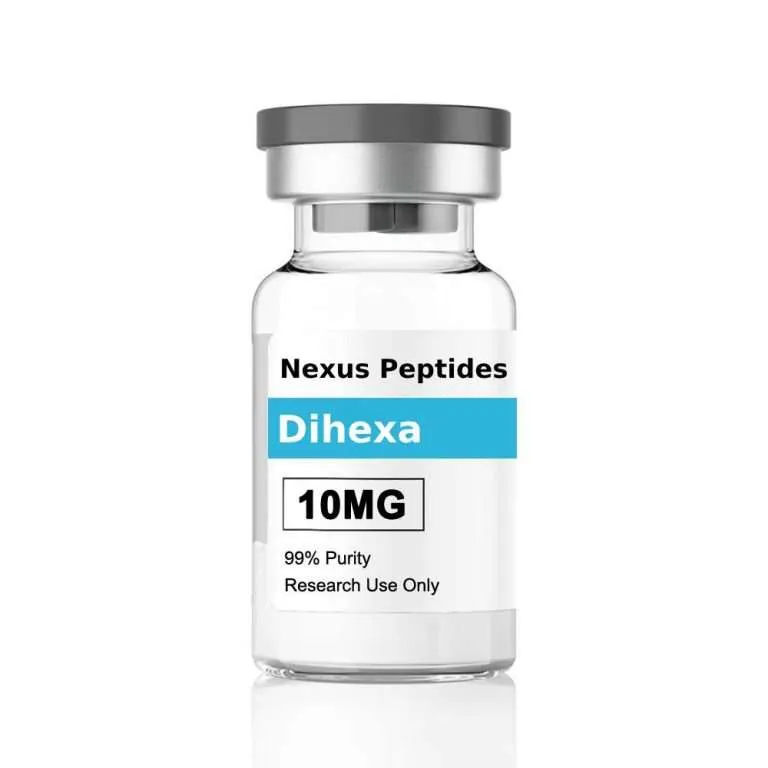
Buy Dihexa: 10-50mg*10 vials
Price range: $150.00 through $485.00
Dihexa 10–50mg × 10 vials for qualified laboratory research involving HGF/c-Met signaling, synaptogenesis, neurobiology, cellular signaling, and experimental cognitive research.
Description
Dihexa is an experimental small-molecule compound that has attracted attention in neuroscience and molecular biology research because of its relationship with the hepatocyte growth factor (HGF)/c-Met signaling system.
Unlike conventional peptides such as MOTS-C or BPC-157, Dihexa is better described scientifically as a synthetic angiotensin IV analog and HGF mimetic. Researchers developed Dihexa from the angiotensin IV-related compound Nle¹-AngIV while investigating molecules with improved metabolic stability and central nervous system activity.
Our Dihexa 10–50mg × 10 vials product is intended for qualified laboratory and research applications involving molecular signaling, neurobiology, synaptogenesis, HGF/c-Met pathways, and experimental cognitive research.
The scientific interest surrounding Dihexa comes largely from preclinical research. Laboratory studies have examined how the compound interacts with HGF and influences c-Met signaling, while animal and cellular models have provided insights into potential effects on neuronal structure and learning-related behavior.
Because the evidence remains experimental, researchers should distinguish clearly between preclinical findings and established human medical applications.
What Is Dihexa?
Dihexa is a synthetic analog related to angiotensin IV.
Its chemical name is commonly given as N-hexanoic-Tyr-Ile-(6)aminohexanoic amide.
The compound became particularly interesting because researchers designed it to address limitations associated with earlier angiotensin IV-related molecules.
Experimental research described Dihexa as metabolically stable and capable of crossing the blood-brain barrier. Researchers subsequently investigated its relationship with HGF and the c-Met receptor system.
This mechanism gives Dihexa a distinctive position within experimental neuroscience research.
Rather than functioning like a traditional peptide hormone, Dihexa has been investigated as a small molecule that can influence a signaling pathway associated with cellular growth, survival, differentiation, and neuronal plasticity.
Dihexa and Angiotensin IV Research
To understand Dihexa, it helps to understand its connection with angiotensin IV.
Angiotensin IV is a peptide fragment derived from the renin-angiotensin system. Researchers have investigated several angiotensin IV-related compounds because of observations involving learning, memory, and neuronal signaling.
However, earlier compounds faced pharmacological limitations.
Scientists therefore developed analogs with altered chemical structures.
Dihexa emerged from this research as a metabolically stabilized analog with properties that made it particularly interesting for experimental neuroscience.
Research subsequently focused on identifying the molecular mechanism responsible for its observed biological activity.
Dihexa and HGF
One of the most important areas of Dihexa research involves hepatocyte growth factor, or HGF.
HGF is a signaling protein that interacts with its receptor, c-Met.
The HGF/c-Met system participates in several biological processes, including:
- Cellular survival
- Cell migration
- Cell growth
- Differentiation
- Tissue development
- Neural signaling
- Cellular repair processes
Researchers investigating Dihexa found evidence that the compound can bind HGF and influence HGF-dependent signaling.
This finding helped provide a potential molecular explanation for some of the biological effects observed in experimental models.
How Does Dihexa Relate to c-Met?
c-Met is the receptor for HGF.
When HGF activates c-Met, the receptor initiates intracellular signaling cascades that can influence several cellular processes.
Research involving Dihexa found that the compound enhanced HGF-dependent c-Met phosphorylation under specific experimental conditions.
This result is important because it suggests that Dihexa does not simply act as a generic stimulant.
Instead, researchers have investigated whether Dihexa modifies HGF activity and thereby influences downstream c-Met signaling.
That mechanism remains a major reason for scientific interest in the compound.
Dihexa and Synaptogenesis Research
Synaptogenesis refers to the formation of synaptic connections between neurons.
This process plays an important role in neuronal development, learning, memory, and nervous-system plasticity.
Researchers have investigated Dihexa because experimental studies reported effects involving hippocampal spinogenesis and synaptogenesis.
In laboratory neuronal models, Dihexa produced changes similar to those associated with HGF. Researchers also found that blocking HGF or c-Met signaling could interfere with these effects.
These observations provide an interesting experimental connection between:
Dihexa → HGF → c-Met → neuronal structural changes
The pathway remains an active area of research.
Dihexa and Hippocampal Research
The hippocampus plays an important role in learning and memory.
Researchers frequently use hippocampal neurons and hippocampal tissue models when studying synaptic plasticity.
Experimental Dihexa studies have examined hippocampal neurons because researchers wanted to understand whether the compound could influence dendritic spine formation and synaptic connectivity.
The findings suggested that Dihexa could promote spinogenesis and synaptogenesis under experimental conditions.
These results do not prove that Dihexa improves memory in humans.
Instead, they provide a mechanistic reason for further neuroscience research.
Dihexa and Cognitive Research
Cognitive research represents one of the most frequently discussed applications of Dihexa.
Experimental studies have investigated learning and memory using animal models.
One study reported that orally administered Dihexa improved performance in a Morris water maze model involving scopolamine-induced cognitive impairment. Importantly, the researchers also found that blocking HGF signaling interfered with the observed effect.
This finding supported the idea that HGF/c-Met signaling contributes to Dihexa’s experimental cognitive effects.
However, animal cognitive studies cannot establish that a compound improves human memory or treats a neurological disorder.
That distinction remains essential when interpreting Dihexa research.
Dihexa and Neurobiology
The nervous system depends on highly coordinated signaling between neurons and supporting cells.
Researchers therefore investigate molecular pathways that influence:
- Neuronal growth
- Synaptic formation
- Dendritic spine development
- Cellular survival
- Neuroplasticity
- Signal transmission
The HGF/c-Met system participates in several of these processes.
Dihexa provides researchers with an experimental tool for investigating how modulation of this pathway may influence neuronal structure and function.
Consequently, Dihexa research sits at the intersection of molecular biology, pharmacology, and neuroscience.
Dihexa and Neuroplasticity
Neuroplasticity describes the nervous system’s ability to change its structure and function in response to experience and environmental conditions.
Synaptic remodeling forms one component of this process.
Because experimental Dihexa research has reported effects on dendritic spines and synaptic structures, scientists have investigated the compound as a tool for studying molecular mechanisms associated with neuroplasticity.
The research does not mean that Dihexa is a proven neuroplasticity treatment.
Rather, it provides a model for examining how HGF/c-Met signaling may influence neuronal connectivity.
Dihexa and HGF-Dependent Signaling
One particularly interesting feature of Dihexa research involves its relationship with HGF.
Researchers found that Dihexa binds HGF with high affinity. They also observed that the compound enhanced HGF-dependent c-Met activation under certain experimental conditions.
These observations led researchers to propose that Dihexa may act as an HGF modulator or mimetic.
The distinction matters because HGF itself is a large protein with pharmacological limitations.
A smaller synthetic molecule that influences the same pathway could offer researchers a useful experimental tool for investigating HGF signaling.
Dihexa and Blood-Brain Barrier Research
The blood-brain barrier creates a major challenge for compounds intended to influence the central nervous system.
Many molecules have difficulty reaching brain tissue in sufficient concentrations.
Experimental research described Dihexa as blood-brain-barrier permeable, which contributed to its interest as a neuroscience research compound.
This characteristic allowed researchers to investigate Dihexa following oral administration in animal models.
However, blood-brain barrier penetration does not automatically establish clinical usefulness.
Researchers must still evaluate pharmacokinetics, tissue distribution, metabolism, safety, and biological effects.
Dihexa and Experimental Cell Research
Cell-based experiments provide another way to investigate the compound.
Researchers have used cellular models to examine the relationship between Dihexa, HGF, and c-Met.
For example, studies involving HEK-293T cells demonstrated increased HGF-dependent c-Met phosphorylation when researchers combined HGF with Dihexa under specific experimental conditions.
Researchers have also used MDCK cells to examine HGF-dependent cellular scattering.
These experiments help scientists understand molecular mechanisms before moving to more complex biological models.
Dihexa and Synaptic Signaling
Synapses allow neurons to communicate with one another.
Changes in synaptic number, structure, and function can influence neural-network behavior.
Experimental Dihexa research has investigated whether HGF/c-Met signaling can influence the formation of functional synaptic structures.
In hippocampal neuron experiments, researchers observed increased dendritic spine formation and evidence of functional synaptic connections following exposure to Dihexa or HGF.
These findings make Dihexa an interesting compound for studying molecular pathways involved in synaptic development and plasticity.
Dihexa and Experimental Neuroregeneration Research
The HGF/c-Met pathway also attracts interest in tissue growth and cellular repair research.
Researchers have investigated HGF signaling in multiple biological contexts, including tissue development and cellular survival.
Because Dihexa can influence HGF-dependent signaling, scientists have explored the compound in experimental models involving neuronal and other cellular processes.
Nevertheless, terms such as “neuroregeneration” should be used carefully.
Experimental pathway activation does not establish that Dihexa repairs neurological injuries or regenerates human nervous tissue.
Dihexa Research and Modern Molecular Biology
Modern molecular biology increasingly focuses on understanding signaling networks rather than studying isolated molecules.
Dihexa provides an interesting example.
Researchers can examine:
- The interaction between Dihexa and HGF.
- HGF-dependent c-Met activation.
- Downstream cellular signaling.
- Changes in neuronal structure.
- Behavioral outcomes in experimental models.
This progression helps researchers connect molecular mechanisms with cellular and organism-level observations.
Dihexa Product Quality
Researchers evaluating Dihexa should look beyond the product name.
Important quality considerations include:
Compound Identity
Confirm the exact compound identity and chemical description.
Purity
Review the stated purity and available analytical information.
Molecular Weight
The expected molecular weight should correspond with the specified compound.
Analytical Testing
Depending on the supplier and research requirements, analytical techniques can help verify identity and composition.
Batch Information
Lot or batch identification improves laboratory traceability.
Packaging
Research materials should arrive in appropriately labeled packaging that clearly identifies the compound and quantity.
Storage Information
Researchers should follow product-specific storage and handling instructions.
How to Evaluate Dihexa Before Purchasing
Researchers comparing Dihexa suppliers should look for transparent product information.
Consider checking:
- Exact compound identity
- Chemical name
- Purity
- Molecular weight
- Analytical testing
- Batch information
- Quantity
- Packaging
- Storage requirements
- Research-use designation
- Supplier contact information
Additionally, avoid choosing a research compound solely because a website makes strong biological claims.
Scientific documentation provides much more useful information than marketing language.
Dihexa 10–50mg × 10 Vials
The product is available in a 10–50mg × 10-vial configuration, depending on the selected product option.
This format provides ten individually packaged vials for laboratory research.
The selected quantity should correspond with the requirements of the intended experimental program.
Researchers should maintain appropriate inventory records and follow the product documentation supplied with the material.
Why Researchers Are Interested in Dihexa
Several characteristics make Dihexa particularly interesting:
- It is an angiotensin IV analog.
- Researchers have investigated its relationship with HGF.
- Studies have linked it with c-Met signaling.
- Experimental work has examined synaptogenesis.
- Researchers have investigated hippocampal neuronal responses.
- Animal studies have explored learning and memory.
- The compound has demonstrated blood-brain-barrier penetration in experimental research.
Together, these characteristics make Dihexa an interesting research compound for studying molecular pathways involved in neurobiology.
Dihexa vs. Conventional Peptides
Dihexa is sometimes grouped together with research peptides on commercial websites.
Scientifically, however, it is more accurate to describe Dihexa as a small-molecule angiotensin IV analog/HGF mimetic.
This distinction matters because peptide chemistry and small-molecule chemistry involve different structural and analytical considerations.
Researchers should therefore confirm the exact chemical identity of the material before designing an experiment.
Dihexa and the Future of Neuroscience Research
Future research may explore Dihexa through increasingly advanced techniques.
Potential research directions include:
- Structural biology
- Molecular docking
- Proteomics
- Single-cell analysis
- Synaptic imaging
- Electrophysiology
- Neuropharmacology
- HGF/c-Met signaling studies
- Computational neuroscience
- Animal behavioral models
These approaches could help researchers determine which effects arise directly from HGF/c-Met signaling and which result from downstream cellular changes.
Human research would also be necessary to determine whether experimental observations translate into clinically meaningful effects.
Current Research Limitations
Dihexa research remains limited in several important ways.
Much of the evidence comes from:
- Cell models
- Cultured neurons
- Animal experiments
- Molecular signaling studies
These models provide valuable mechanistic information. However, they do not establish long-term human safety or therapeutic efficacy.
Researchers still need more information about:
- Human pharmacokinetics
- Long-term safety
- Appropriate exposure levels
- Metabolism
- Potential off-target effects
- Drug interactions
- Human clinical efficacy
Therefore, Dihexa should remain firmly categorized as an experimental research compound.
Research-Use Statement
Dihexa is presented as an experimental research compound for qualified laboratory applications.
It is not presented as an approved medication, dietary supplement, or established treatment for memory loss, dementia, Alzheimer’s disease, neurological disorders, or any other medical condition.
Preclinical findings involving cells or animals should not be interpreted as proof of human therapeutic efficacy.
Researchers should follow applicable laboratory procedures, institutional requirements, safety protocols, and product-specific handling instructions.
Frequently Asked Questions
What is Dihexa?
Dihexa is a synthetic angiotensin IV analog that researchers have investigated as an HGF mimetic and modulator of HGF/c-Met signaling.
Is Dihexa a peptide?
Despite frequently appearing on peptide research websites, Dihexa is more accurately described as a small-molecule angiotensin IV analog rather than a conventional peptide.
What is Dihexa studied for?
Research has investigated Dihexa in areas including HGF/c-Met signaling, synaptogenesis, neuronal plasticity, neurobiology, and experimental cognitive models.
How does Dihexa relate to HGF?
Experimental research found that Dihexa binds HGF and can enhance HGF-dependent c-Met signaling under certain laboratory conditions.
Does Dihexa affect synapses?
Experimental studies have reported increased hippocampal spinogenesis and synaptogenesis following Dihexa exposure. Researchers linked these effects to the HGF/c-Met pathway.
Has Dihexa been studied in animals?
Yes. Experimental animal research has examined Dihexa in learning and memory models, including the Morris water maze.
Is Dihexa an approved treatment for Alzheimer’s disease?
No. Experimental research should not be presented as evidence that Dihexa is an approved or proven treatment for Alzheimer’s disease or dementia.
Does Dihexa cross the blood-brain barrier?
Experimental research has described Dihexa as blood-brain-barrier permeable, which contributed to its investigation in neuroscience models.
What should researchers check before buying Dihexa?
Verify the exact compound identity, purity, molecular weight, analytical information, batch details, quantity, packaging, storage requirements, and research-use designation.
What does 10–50mg × 10 vials mean?
It indicates a configuration containing ten individual vials, with the selected option containing either 10mg or 50mg per vial
Additional information
| Quantity | 10mg * 10vials, 50mg * 10vials |
|---|
Related products
-
Buy MOTS-C: 5-10mg*10 vials
Price range: $111.99 through $179.99 Select options This product has multiple variants. The options may be chosen on the product page -

Buy Gonadorelin: 2-5-10mg*10 vials
Price range: $120.99 through $250.99 Select options This product has multiple variants. The options may be chosen on the product page -
Buy Kisspeptin: 5-10mg*10 vials
Price range: $130.99 through $230.99 Select options This product has multiple variants. The options may be chosen on the product page -
Bacteriostatic Water: 3ml*10 vials (30ml)
$22.00 Add to cart
Reviews
There are no reviews yet.