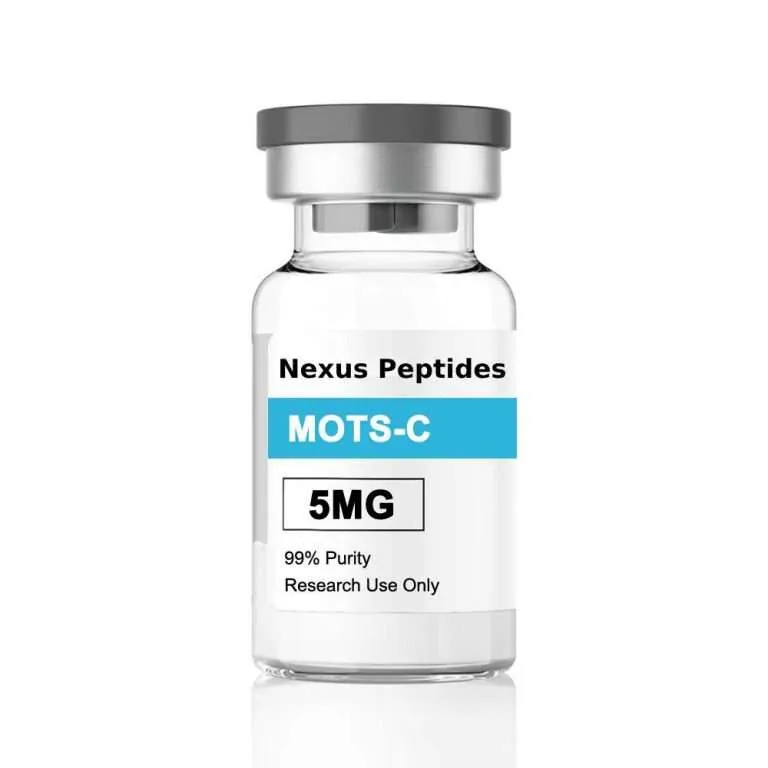
Buy MOTS-C: 5-10mg*10 vials
Price range: $111.99 through $179.99
MOTS-C 5–10mg × 10 vials for qualified laboratory research involving mitochondrial biology, metabolic signaling, AMPK pathways, cellular stress, exercise-related research, and aging studies.
Description
MOTS-C Peptide 5–10mg × 10 Vials
MOTS-C has attracted significant interest in mitochondrial and metabolic research. This short peptide contains 16 amino acids and originates from a small open reading frame associated with the mitochondrial 12S rRNA region. Unlike many familiar peptides encoded by nuclear DNA, MOTS-C belongs to a growing group of mitochondrial-derived peptides that researchers study for their potential role in cellular signaling and metabolic regulation.
Scientists first identified MOTS-C in research examining previously unrecognized coding regions within mitochondrial DNA. Early experiments connected the peptide with metabolic homeostasis, insulin sensitivity, glucose regulation, and AMPK-related signaling. Consequently, MOTS-C has become an important subject in research involving mitochondrial biology, cellular metabolism, exercise physiology, and aging.
Our MOTS-C 5–10mg × 10 vials product is intended for qualified laboratory research. Researchers investigating mitochondrial signaling, metabolic pathways, cellular stress, and related biological mechanisms may find this peptide relevant to their experimental work.
What Is MOTS-C?
MOTS-C is a 16-amino-acid mitochondrial-derived peptide. The name refers to mitochondrial open reading frame of the 12S rRNA-c.
Its unusual genetic origin makes MOTS-C particularly interesting. Mitochondria traditionally receive attention because of their central role in cellular energy production. However, modern research shows that mitochondrial genetic material can also produce small peptides with signaling functions.
The discovery of MOTS-C therefore expanded scientific interest in mitochondrial communication.
Researchers continue to examine how this peptide may connect mitochondrial activity with cellular metabolism, stress responses, and energy regulation.
MOTS-C and Mitochondrial Research
Mitochondria perform far more functions than simply producing cellular energy. They also participate in metabolic signaling, oxidative-stress responses, calcium regulation, apoptosis, and cellular adaptation.
MOTS-C provides researchers with an interesting model for studying these relationships.
For example, scientists have investigated whether MOTS-C can communicate information about metabolic conditions from mitochondria to other parts of the cell. Under certain experimental conditions, researchers have also examined its movement toward the nucleus and its potential influence on gene-regulatory processes.
As a result, MOTS-C research connects several areas of molecular biology that were once considered more separate.
MOTS-C and AMPK
AMP-activated protein kinase, commonly known as AMPK, plays an important role in cellular energy regulation.
When cells experience changes in their energy balance, AMPK helps coordinate processes that restore energy homeostasis. Researchers have therefore taken considerable interest in molecules that interact with this pathway.
Early MOTS-C research connected the peptide with metabolic pathways involving the folate cycle and purine biosynthesis. Those findings also linked MOTS-C with AMPK activation in experimental models.
Therefore, researchers continue to investigate MOTS-C as a potential molecular connection between mitochondrial activity and cellular energy sensing.
Importantly, these findings do not establish MOTS-C as a proven human treatment. Instead, they provide a foundation for further laboratory investigation.
MOTS-C and Glucose Metabolism
Glucose metabolism represents another major area of MOTS-C research.
Cells must constantly balance glucose availability with energy requirements. Mitochondria contribute to this process by helping cells convert nutrients into usable energy.
Early animal research reported changes in insulin sensitivity and metabolic homeostasis following experimental MOTS-C exposure. These observations encouraged further investigation into the relationship between MOTS-C and glucose metabolism.
Researchers now examine several related mechanisms, including:
- Glucose utilization
- Insulin signaling
- Cellular energy balance
- Skeletal-muscle metabolism
- Metabolic stress
- Mitochondrial function
Nevertheless, preclinical findings require careful interpretation. Results from animal or cell models do not automatically demonstrate the same effects in humans.
MOTS-C and Insulin Research
Insulin signaling allows cells to respond appropriately to changes in circulating glucose. Because MOTS-C research has produced findings related to insulin sensitivity, scientists continue to examine the peptide within metabolic research models.
The original discovery study reported that MOTS-C influenced metabolic responses in mice, including changes associated with insulin sensitivity and diet-induced metabolic dysfunction.
Those findings generated considerable scientific interest. Since then, researchers have explored additional mechanisms that could explain the relationship between mitochondrial signaling and insulin response.
However, MOTS-C should not be presented as an established treatment for diabetes or insulin resistance. Current research does not justify such a claim.
MOTS-C and Exercise Research
Exercise creates a substantial increase in cellular energy demand. Muscle cells must adapt quickly as energy consumption rises, while mitochondrial activity and metabolic signaling also change.
MOTS-C has attracted attention in this area because researchers have observed relationships between the peptide and metabolic responses associated with exercise.
Scientists have investigated MOTS-C in connection with:
- Skeletal-muscle metabolism
- Energy utilization
- Exercise adaptation
- Glucose regulation
- Mitochondrial signaling
- Cellular stress
Some online sources describe MOTS-C as an “exercise mimetic.” That phrase requires caution, however. Experimental research does not demonstrate that MOTS-C replaces exercise or produces all of the physiological effects associated with physical activity.
Instead, researchers use the term to describe specific molecular pathways that may overlap with certain exercise-related signaling mechanisms.
MOTS-C and Skeletal Muscle
Skeletal muscle consumes substantial amounts of energy and plays an important role in glucose metabolism. Consequently, researchers have paid close attention to the relationship between MOTS-C and muscle biology.
Experimental studies have examined the peptide in relation to metabolic adaptation, glucose utilization, mitochondrial function, and exercise-related signaling.
This research may help scientists understand how mitochondria communicate with muscle cells when energy demand changes.
The findings remain an area of active investigation rather than established clinical evidence.
MOTS-C and Aging Research
Aging research represents another rapidly developing area for MOTS-C.
Mitochondrial function changes as organisms age. At the same time, researchers investigate alterations in metabolism, cellular stress responses, and energy regulation.
Because MOTS-C participates in mitochondrial-derived signaling, scientists have explored whether the peptide could have a role in age-associated biological changes.
Studies and reviews have discussed possible relationships between MOTS-C and metabolic health, cellular stress, cardiovascular biology, and other areas of aging research.
However, the phrase “anti-aging peptide” can oversimplify the science.
MOTS-C remains an experimental research molecule. Researchers still need more evidence to determine its long-term biological effects and potential relevance to human aging.
MOTS-C and Cellular Stress
Cells constantly respond to changes in their environment. Nutrient availability, exercise, oxidative stress, and energy demand can all alter cellular conditions.
Mitochondria play a central role in many of these responses.
Researchers have therefore investigated whether MOTS-C participates in cellular adaptation during metabolic stress.
Some experimental studies suggest that MOTS-C can move toward the nucleus under particular stress conditions. Once there, the peptide may interact with processes involved in gene regulation.
This possibility makes MOTS-C especially interesting because it could provide a communication pathway between mitochondrial status and nuclear responses.
MOTS-C and Metabolic Homeostasis
Metabolic homeostasis requires several systems to work together.
These include:
- Glucose metabolism
- Fat metabolism
- Mitochondrial activity
- Energy production
- Hormonal signaling
- Nutrient availability
- Cellular energy demand
MOTS-C research examines how a mitochondrial-derived peptide might influence some of these interconnected systems.
The original discovery research described MOTS-C as a potential regulator of metabolic homeostasis in experimental models. Subsequent research has continued to explore the molecular mechanisms behind those observations.
As the field develops, researchers may gain a clearer understanding of how mitochondrial peptides influence broader metabolic networks.
MOTS-C and Obesity Research
MOTS-C also appears frequently in research discussions surrounding obesity and metabolic dysfunction.
Early mouse research reported effects related to diet-induced metabolic changes. These observations encouraged scientists to examine whether mitochondrial-derived peptides could influence energy metabolism.
Nevertheless, laboratory research should not be confused with a clinically established weight-management treatment.
A responsible research discussion should distinguish between:
Experimental findings: observations made in laboratory or animal models.
Clinical evidence: results demonstrated through appropriately designed human studies.
For MOTS-C, these two categories should not be treated as equivalent.
MOTS-C Product Quality
Researchers should evaluate several factors when selecting a MOTS-C research peptide.
Peptide Identity
First, verify that the supplier clearly identifies the material as MOTS-C and provides the relevant sequence information.
Purity
Next, examine the stated purity and available analytical documentation.
A high-quality research supplier should make relevant quality information accessible rather than relying solely on marketing language.
Molecular Mass
The expected molecular mass should correspond with the stated peptide sequence and any modifications.
Analytical Testing
Where available, HPLC and mass spectrometry can help characterize peptide identity and purity.
For research laboratories, analytical information can provide useful evidence when evaluating whether a product meets experimental requirements.
Batch Information
Lot or batch identification also matters. Proper batch records improve traceability and help laboratories maintain consistent research documentation.
Storage Information
Finally, researchers should review the supplier’s storage recommendations and follow the handling requirements associated with the specific product.
How to Evaluate MOTS-C Before Purchasing
Online peptide suppliers can differ considerably in the amount of information they provide.
Before purchasing a research peptide, consider checking:
- Exact peptide identity
- Amino-acid sequence
- Purity information
- Molecular mass
- Analytical testing
- Batch or lot information
- Product quantity
- Packaging
- Storage requirements
- Research-use labeling
- Supplier transparency
Additionally, avoid judging a research peptide solely by its advertised biological claims.
A product page that provides clear scientific information allows researchers to make a more informed purchasing decision.
MOTS-C 5–10mg × 10 Vials
The MOTS-C product is available in 5–10mg × 10-vial configurations, depending on the selected option.
The multi-vial format may suit laboratories that organize research materials across multiple experiments or projects.
Each vial should remain properly identified according to the laboratory’s inventory and documentation procedures.
Researchers should also follow the product-specific information supplied with the material.
Why MOTS-C Is Scientifically Interesting
MOTS-C stands out because its origin challenges the traditional view of mitochondrial genetics.
Scientists once focused primarily on the role of mitochondrial DNA in producing components required for mitochondrial function. The discovery of mitochondrial-derived peptides revealed another possibility: mitochondrial genetic material can also encode small signaling molecules.
MOTS-C provides a particularly interesting example of this concept.
Consequently, its research connects mitochondrial genetics, cellular metabolism, molecular signaling, and aging biology.
The Future of MOTS-C Research
The future of MOTS-C research may involve increasingly sophisticated technologies.
Researchers could combine MOTS-C studies with:
- Metabolomics
- Proteomics
- Single-cell analysis
- Computational biology
- Structural biology
- Mitochondrial imaging
- Exercise physiology
- Aging research
- Metabolic disease models
These techniques may help scientists determine which biological effects result directly from MOTS-C and which arise indirectly through broader metabolic pathways.
Human research will also remain important.
More data on pharmacology, distribution, metabolism, safety, and biological activity could help researchers understand how findings from laboratory models relate to human biology.
Research-Use Statement
MOTS-C is presented as an experimental research peptide for qualified laboratory applications.
This product should not be represented as an approved medication, dietary supplement, or established treatment for obesity, diabetes, aging, cardiovascular disease, or another medical condition.
Furthermore, laboratory and animal findings do not automatically demonstrate therapeutic effects in humans.
Researchers should follow applicable laboratory procedures, institutional requirements, safety protocols, and product-specific handling instructions.
Frequently Asked Questions
What is MOTS-C?
MOTS-C is a 16-amino-acid mitochondrial-derived peptide associated with a short open reading frame in the mitochondrial 12S rRNA region.
What is MOTS-C studied for?
Researchers study MOTS-C in areas such as mitochondrial biology, metabolic signaling, AMPK pathways, glucose metabolism, exercise-related signaling, cellular stress, and aging.
Does MOTS-C affect AMPK?
Experimental research has linked MOTS-C with AMPK-related metabolic signaling. However, researchers continue to investigate the precise mechanisms involved.
Is MOTS-C an anti-aging treatment?
No. Scientists investigate MOTS-C in aging biology, but current research does not establish it as a proven anti-aging treatment.
Is MOTS-C a weight-loss treatment?
MOTS-C has generated interest because of preclinical metabolic research. However, laboratory findings should not be presented as proof that MOTS-C is an established weight-loss treatment.
Is MOTS-C a GLP-1 peptide?
No. MOTS-C and GLP-1-based peptides have different molecular origins and biological mechanisms.
What should I check before buying MOTS-C?
Check the exact identity, sequence, purity, molecular mass, analytical documentation, batch information, quantity, storage requirements, and research-use designation.
What does 5–10mg × 10 vials mean?
The configuration contains ten individual vials, with the selected option providing either 5mg or 10mg per vial.
Additional information
| Quantity | 5mg * 10vials, 10mg * 10vials |
|---|
Related products
-
Buy SS31: 5-10mg*10 vials
Price range: $220.00 through $390.00 Select options This product has multiple variants. The options may be chosen on the product page -

Buy HCG 5000iu/vial *10vial/box
$190.00 Add to cart -

Buy Pinealon: 5-10mg*10 vials
Price range: $120.00 through $180.00 Select options This product has multiple variants. The options may be chosen on the product page -
Buy Angiotesin 2: 5-10mg*10 vials
Price range: $120.99 through $190.99 Select options This product has multiple variants. The options may be chosen on the product page
Reviews
There are no reviews yet.