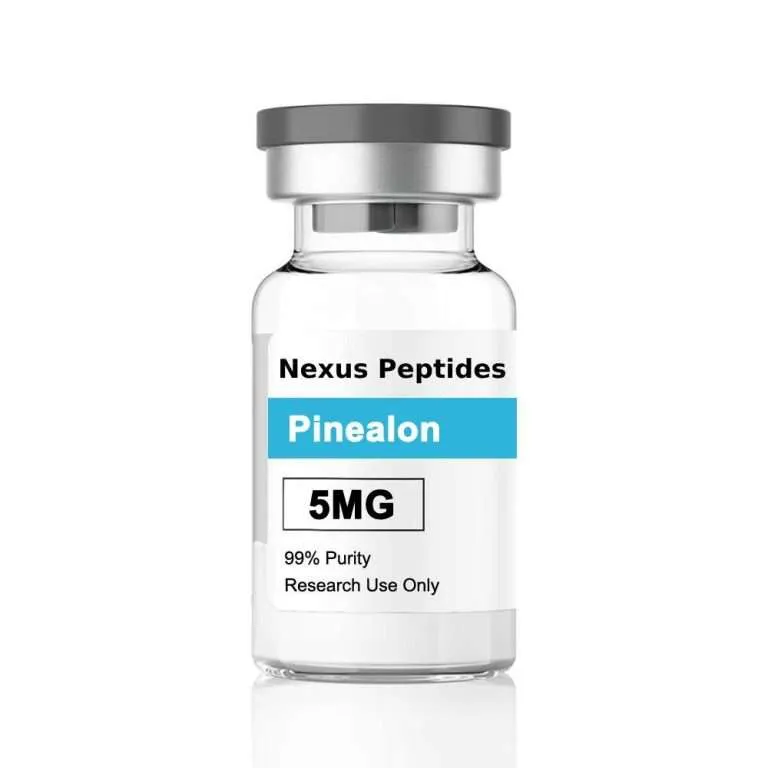
Buy Pinealon: 5-10mg*10 vials
Price range: $120.00 through $180.00
Pinealon 5–10mg × 10 vials for qualified research and laboratory applications. Explore Pinealon peptide research involving molecular biology, cellular processes, neurobiology, and aging-related research.
Description
Pinealon Peptide 5–10 mg × 10 Vials for Research
Pinealon is a short synthetic peptide that has attracted interest in research involving molecular biology, cellular regulation, neurobiology, and aging-related biological processes. It belongs to a broader area of peptide research focused on how small peptide sequences may interact with cellular systems and influence biological signaling.
Our Pinealon 5–10 mg × 10 vials product is intended for qualified laboratory and research applications. It is suitable for researchers investigating peptide structure, molecular interactions, cellular processes, neurobiological pathways, and other areas where Pinealon may be relevant to an experimental research model.
Interest in Pinealon has grown alongside broader scientific interest in short bioactive peptides, aging biology, and peptide-based molecular research. However, it is important to distinguish scientific investigation from established clinical evidence. Much of the discussion surrounding Pinealon and related peptides involves experimental or preclinical research, and evidence should be evaluated according to the quality and type of study available.
What Is Pinealon?
Pinealon is commonly described as a short synthetic peptide associated with research into biological regulation and aging-related processes.
It is often discussed within the field of peptide bioregulator research, a research area that examines short peptides and their potential interactions with biological systems.
Researchers interested in Pinealon may investigate questions involving:
- Cellular regulation
- Gene-expression-related processes
- Neurobiology
- Aging biology
- Cellular stress
- Peptide signaling
- Molecular interactions
- Protein and peptide biology
- Experimental longevity research
Because Pinealon is a relatively small peptide, researchers can also use it as an interesting model for studying how short amino-acid sequences interact with biological environments.
Why Is Pinealon Interesting to Researchers?
One reason Pinealon attracts attention is its connection to research exploring how short peptides may influence cellular processes.
The study of short peptides has expanded considerably because researchers can investigate their structure, stability, receptor interactions, intracellular behavior, and potential biological effects using a variety of laboratory models.
Pinealon is therefore part of a broader scientific conversation surrounding:
Peptide biology
How do small amino-acid sequences interact with biological systems?
Cellular signaling
Can short peptides participate in signaling pathways or influence cellular responses?
Aging biology
How do molecular and cellular processes change with age, and can specific biological pathways be studied using peptide models?
Neurobiology
How do peptide molecules interact with systems involved in nervous-system function?
Molecular research
What structural characteristics determine how a short peptide behaves under experimental conditions?
These questions make Pinealon an interesting subject for laboratory investigation.
Pinealon and Aging Research
Aging research is one of the areas in which Pinealon is frequently discussed.
Modern aging biology examines aging as a complex process involving multiple interacting mechanisms rather than a single biological pathway.
Researchers study factors such as:
- Cellular senescence
- Oxidative stress
- Mitochondrial function
- DNA maintenance
- Protein homeostasis
- Inflammation
- Cellular signaling
- Epigenetic regulation
- Tissue regeneration
- Neurobiological changes
Peptides are being investigated across many of these areas because small peptide molecules can provide useful experimental models for studying specific biological processes.
Pinealon has therefore attracted interest within experimental research discussions concerning cellular aging and age-associated biological changes.
However, readers should be careful with claims that Pinealon has been definitively proven to extend human lifespan or reverse aging. Such claims go beyond what can reasonably be concluded from limited experimental evidence.
Pinealon and Neurobiology Research
Another area of interest is neurobiology.
The nervous system relies on highly complex networks involving neurons, receptors, signaling molecules, proteins, and cellular communication pathways.
Researchers investigating peptide biology may examine how specific short peptides interact with neural systems or cellular models.
Pinealon has been discussed in research contexts involving neurological and cognitive biology, although the strength of evidence varies considerably depending on the specific claim being examined.
For researchers, this makes it important to distinguish between:
- Laboratory observations
- Animal studies
- Mechanistic hypotheses
- Human clinical research
- Established medical applications
These categories should never be treated as equivalent.
Pinealon and Molecular Biology
Pinealon is also relevant to researchers interested in the relationship between peptide structure and biological activity.
A peptide’s biological behavior depends on numerous factors, including:
- Amino-acid sequence
- Molecular structure
- Conformation
- Charge
- Hydrophobicity
- Stability
- Interactions with other molecules
- Experimental environment
Researchers can study these characteristics using different analytical and experimental approaches.
Depending on the research question, peptide investigations may involve techniques such as chromatography, mass spectrometry, spectroscopy, cell-based assays, and molecular modeling.
This broader analytical framework is important when evaluating experimental peptide materials.
Why Peptide Purity Matters
When purchasing a research peptide, purity and identity are important considerations.
A researcher should not evaluate a peptide solely by its product name or stated quantity.
Important factors may include:
- Peptide identity
- Stated quantity
- Purity information
- Analytical characterization
- Batch information
- Packaging
- Labeling
- Storage requirements
- Supplier transparency
Analytical techniques such as HPLC can be used in peptide characterization, while mass spectrometry may provide information related to molecular mass and identity.
A researcher’s specific analytical requirements will depend on the intended experiment.
For this reason, responsible peptide suppliers should provide clear product information and avoid making unsupported claims about experimental materials.
Pinealon 5–10 mg × 10 Vials
Our Pinealon product is available in a 5–10 mg × 10-vial configuration, depending on the selected product option.
The multiple-vial format can be useful for laboratories organizing research materials across different experiments or research workflows.
Each research environment has its own requirements for handling, storage, documentation, and analytical verification. Researchers should follow the applicable laboratory procedures and manufacturer-provided storage information for the specific product.
Pinealon Research Applications
Depending on the experimental design, Pinealon may be relevant to research involving:
- Peptide biology
- Molecular biology
- Cellular biology
- Neurobiology
- Aging biology
- Longevity research
- Cellular stress research
- Peptide chemistry
- Structure-activity research
- Experimental signaling studies
- Laboratory peptide analysis
The appropriate application depends on the research question and experimental model.
Pinealon should not be presented as a guaranteed intervention for aging, cognitive decline, or any other medical condition.
How to Evaluate a Pinealon Research Peptide
Researchers looking for Pinealon should consider more than price alone.
A responsible evaluation can include examining:
Product identity
The product should clearly identify the peptide and stated quantity.
Analytical information
Where available, researchers can review analytical documentation relevant to the material.
Purity
Purity information can help researchers understand the characterization of a product, although purity alone does not establish suitability for every experiment.
Packaging
Appropriate packaging can help protect the research material during transportation and storage.
Labeling
Clear labeling helps laboratories maintain accurate inventory and sample identification.
Supplier transparency
A supplier should clearly distinguish research products from approved medicines and avoid unsupported health claims.
Pinealon vs. Other Research Peptides
Pinealon belongs to a broad and diverse category of experimental peptides.
Different peptides can be investigated for completely different biological questions.
For example:
| Research Area | Example Peptide Categories |
|---|---|
| Neurobiology | Neuroactive and signaling peptides |
| Aging research | Experimental longevity-related peptides |
| Metabolic research | Metabolic signaling peptides |
| Growth-hormone research | GHRH/GH-related peptides |
| Tissue research | Experimental regenerative peptides |
| Receptor research | Ligand and receptor-targeting peptides |
This means researchers should select a peptide according to the scientific question rather than simply choosing the peptide that is currently most popular online.
The Future of Pinealon Research
The broader field of peptide research continues to develop as scientists gain better tools for studying molecular interactions, cellular signaling, and peptide structure.
Advances in:
- Computational biology
- Molecular modeling
- Peptide synthesis
- Analytical chemistry
- Mass spectrometry
- Cell-based research
- Proteomics
- Artificial intelligence
may provide researchers with new ways to investigate short peptides and their biological behavior.
For Pinealon specifically, additional high-quality research would be valuable for clarifying its mechanisms, biological effects, and potential applications.
As with many experimental peptides, the most useful approach is to evaluate new findings according to the strength of the evidence rather than relying on promotional claims.
Research-Use Statement
Pinealon is discussed here as an experimental research peptide.
This product is intended for qualified research and laboratory use only and is not marketed as a drug, dietary supplement, or approved treatment.
Nothing on this page should be interpreted as medical advice, a diagnosis, or a recommendation to use Pinealon for treating or preventing a disease or medical condition.
Researchers should follow appropriate laboratory procedures, applicable regulations, and institutional requirements when working with research peptides.
FREQUENTLY ASKED QUESTIONS
What is Pinealon?
Pinealon is a short synthetic peptide that has been discussed in research involving molecular biology, neurobiology, cellular processes, and aging-related research.
What is Pinealon used for in research?
Research interest surrounding Pinealon includes experimental investigations into cellular regulation, neurobiology, aging-related processes, and peptide biology. Specific applications depend on the research model.
Is Pinealon a research peptide?
Pinealon is commonly discussed as an experimental/research peptide. Research status should not be confused with regulatory approval for human medical use.
Why are researchers interested in Pinealon?
Researchers are interested in Pinealon because short peptides can provide useful models for studying molecular interactions, cellular signaling, and biological regulation.
Is Pinealon approved as a medicine?
Pinealon should not be represented as an approved treatment for a medical condition. Regulatory status varies by jurisdiction, and researchers should consult applicable authorities for current information.
What does 5–10 mg × 10 vials mean?
It refers to a product configuration containing ten individual vials, with the selected option containing either 5 mg or 10 mg per vial.
How should Pinealon research material be stored?
Storage requirements should be determined from the specific product documentation and applicable laboratory procedures. Researchers should follow the supplier’s stated storage instructions.
What should I look for when purchasing Pinealon for research?
Consider product identity, stated quantity, analytical information, labeling, packaging, storage information, supplier transparency, and documentation relevant to your research requirements.
KEY TAKEAWAYS
- Pinealon is a short synthetic peptide of interest in experimental peptide research.
- Research discussions surrounding Pinealon include molecular biology, neurobiology, cellular processes, and aging-related biology.
- Evidence should be evaluated according to the quality and type of research available.
- Peptide purity, identity, analytical characterization, packaging, and documentation are important considerations for laboratory research.
- Pinealon should not be represented as a proven treatment for aging, cognitive conditions, or other diseases.
- The Pinealon 5–10 mg × 10 vials configuration is intended for qualified research and laboratory applications.
Additional information
| Quantity | 5mg * 10vials, 10mg * 10vials |
|---|
Related products
-
Buy Dihexa: 10-50mg*10 vials
Price range: $150.00 through $485.00 Select options This product has multiple variants. The options may be chosen on the product page -
Buy Angiotesin 2: 5-10mg*10 vials
Price range: $120.99 through $190.99 Select options This product has multiple variants. The options may be chosen on the product page -
Buy Thymalin: 5-10mg*10 vials
Price range: $120.00 through $190.00 Select options This product has multiple variants. The options may be chosen on the product page -
Buy AOD 9604: 2-5mg*10 vials
Price range: $130.99 through $270.99 Select options This product has multiple variants. The options may be chosen on the product page
Reviews
There are no reviews yet.