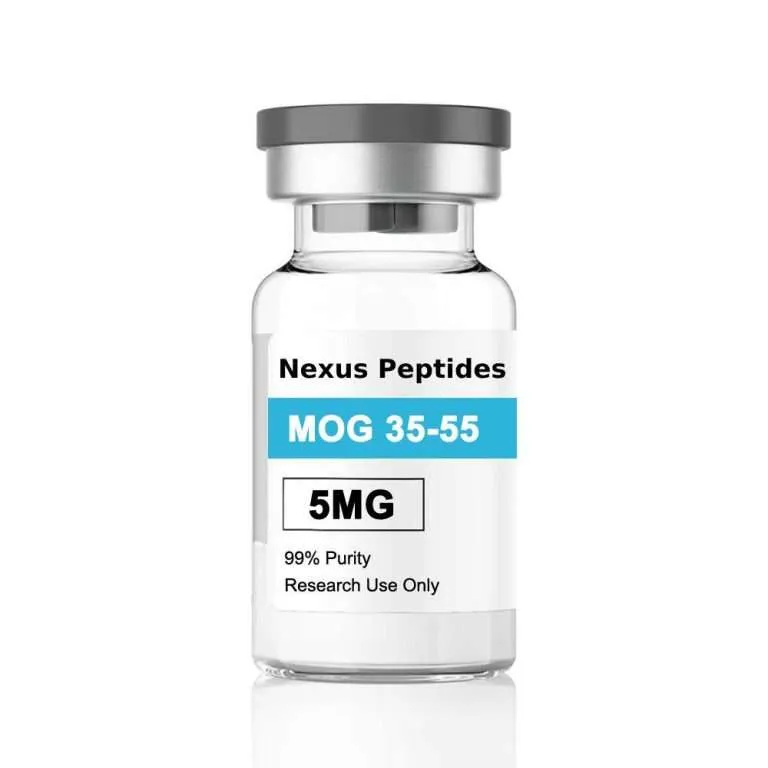
Buy Mog 35-55 online
$339.99
MOG 35–55 peptide 5–10mg × 10 vials for qualified laboratory research involving neuroimmunology, T-cell biology, experimental autoimmune encephalomyelitis, peptide-MHC interactions, and autoimmune research.
Description
MOG 35–55 is a synthetic peptide derived from myelin oligodendrocyte glycoprotein (MOG) and is one of the best-known experimental peptides used in neuroimmunology research.
The peptide is particularly recognized for its role in experimental autoimmune encephalomyelitis, commonly abbreviated EAE, an animal model used to investigate immune-mediated inflammation and demyelination of the central nervous system.
Our MOG 35–55 5–10mg × 10 vials product is intended for qualified research and laboratory applications involving immunology, neuroimmunology, T-cell biology, peptide-MHC interactions, autoimmune research, and experimental CNS inflammation models.
MOG35–55 is not simply a general-purpose peptide. It has a very specific place in experimental immunology because its interaction with antigen-presenting cells and T-cell receptors can be used to investigate antigen-specific immune responses.
Researchers have used MOG35–55 in a wide variety of experimental systems to investigate mechanisms associated with EAE and immune-mediated CNS inflammation.
What Is MOG 35–55?
MOG 35–55 refers to a peptide segment corresponding to amino-acid residues 35 through 55 of myelin oligodendrocyte glycoprotein.
MOG is a protein associated with the myelin sheath of the central nervous system.
The 35–55 region of MOG has become particularly important in experimental neuroimmunology because it contains an immunologically relevant peptide sequence that can interact with antigen-presentation systems and stimulate peptide-specific T-cell responses in appropriate experimental models.
The precise sequence is important.
Researchers should therefore verify whether their experimental material corresponds to:
- Human MOG35–55
- Mouse MOG35–55
- Rat MOG35–55
- Amidated MOG35–55
- Non-amidated MOG35–55
- Modified or cyclic MOG35–55
- Another MOG-derived peptide
Published structural research has demonstrated that human and rat MOG35–55 are not identical and can exhibit different biological behavior in experimental systems.
For reproducible research, the exact peptide identity and sequence should always be confirmed.
MOG35–55 and Experimental Autoimmune Encephalomyelitis
One of the most important applications of MOG35–55 is research involving experimental autoimmune encephalomyelitis (EAE).
EAE is an experimental model used to investigate immune-mediated inflammation and demyelination within the central nervous system.
MOG35–55 has been used to induce or study EAE in susceptible experimental animals, allowing researchers to investigate mechanisms involving:
- Antigen-specific T cells
- Neuroinflammation
- Demyelination
- CNS immune responses
- Cytokine signaling
- T-cell activation
- Immune tolerance
- Antigen presentation
- Myelin-related immune responses
Importantly, EAE is an experimental animal model and should not be treated as equivalent to human multiple sclerosis.
Researchers use EAE because it provides a controlled experimental system for investigating mechanisms of immune-mediated CNS disease.
Why Is MOG35–55 So Important in EAE Research?
MOG35–55 provides researchers with a defined antigenic peptide that can be incorporated into controlled experimental systems.
This is useful because researchers can study immune responses against a specific peptide sequence rather than relying solely on complex biological mixtures.
In appropriate mouse models, MOG35–55 can generate peptide-specific immune responses that are useful for investigating the cellular and molecular mechanisms involved in EAE.
Research has examined how MOG35–55 influences pathways involving T cells, cytokines, antigen presentation, and intracellular signaling.
MOG35–55 and T-Cell Research
T cells are central to many experimental models involving MOG35–55.
When a peptide is presented by an appropriate major histocompatibility complex (MHC) molecule, it can be recognized by a compatible T-cell receptor.
This creates an experimental system in which researchers can examine:
- T-cell activation
- T-cell proliferation
- Cytokine production
- T-cell differentiation
- Antigen-specific responses
- T-cell tolerance
- Regulatory mechanisms
- Immune-cell migration
MOG35–55 has therefore become a useful experimental antigen for investigating peptide-specific T-cell biology.
Studies have also identified distinct MOG35–55-reactive T-cell populations and examined their contributions to CNS inflammation in EAE models.
MOG35–55 and Peptide-MHC Interactions
A major part of MOG35–55 research involves understanding the interaction between peptide antigens and MHC class II molecules.
Antigen presentation is a fundamental mechanism of adaptive immunity.
A peptide is processed and presented by an MHC molecule, allowing a T-cell receptor to recognize the peptide-MHC complex.
Researchers can use defined peptides such as MOG35–55 to investigate these interactions under controlled experimental conditions.
This allows scientists to examine questions such as:
- Which peptide residues are important for recognition?
- How does sequence variation alter MHC binding?
- How does peptide structure influence recognition?
- How do different MHC alleles interact with the peptide?
- How does altered peptide structure affect T-cell activation?
Structural research has demonstrated that changes in the sequence or conformation of MOG-derived peptides can influence their interactions with MHC molecules.
Human vs. Rodent MOG35–55
This is one of the most important details for researchers purchasing MOG35–55.
MOG35–55 is not necessarily identical across species.
Research comparing human and rat MOG35–55 has identified a sequence difference involving residue 42. The two peptides can consequently exhibit different structural and biological characteristics.
This means researchers should never purchase a MOG35–55 product solely based on the name.
Before ordering, verify:
- Species origin
- Exact sequence
- Terminal modifications
- Purity
- Molecular weight
- Quantity
- Analytical characterization
The exact identity can be critical to experimental reproducibility.
MOG35–55 and Neuroinflammation Research
MOG35–55 has become an important experimental tool for studying neuroinflammation.
The central nervous system has specialized immune-regulatory mechanisms, and researchers use experimental models to investigate what happens when immune responses become directed toward CNS-associated antigens.
MOG35–55 can therefore be incorporated into studies examining:
- CNS inflammation
- Immune-cell infiltration
- Myelin-associated immune responses
- Cytokine pathways
- T-cell responses
- Microglial biology
- Astrocyte responses
- Axonal injury
- Demyelination
Research involving MOG35–55 has helped scientists investigate molecular pathways associated with EAE, including inflammatory signaling pathways such as JAK/STAT and NF-κB-related mechanisms.
MOG35–55 and Immune Tolerance Research
Another major area of interest is antigen-specific immune tolerance.
Rather than broadly suppressing the immune system, researchers are investigating whether immune responses can be selectively modified based on recognition of a particular antigen.
MOG35–55 provides a defined antigenic target for studying these concepts.
Experimental research has examined MOG35–55-based approaches involving:
- T-cell tolerance
- Antigen-specific immune regulation
- Altered peptide ligands
- Dendritic-cell biology
- Regulatory immune responses
- Peptide-MHC interactions
Some studies have investigated modified or conjugated forms of MOG35–55 rather than the unmodified peptide itself.
This distinction matters: a modified MOG35–55 construct should not automatically be considered equivalent to standard MOG35–55.
Modified MOG35–55 Peptides
Researchers have investigated several modifications of MOG35–55.
Examples include:
- Cyclic MOG35–55
- Conjugated MOG35–55
- Altered peptide ligands
- Modified amino-acid variants
- Citrullinated MOG-derived peptides
These modifications can change peptide structure, MHC interactions, stability, and biological behavior.
For example, research on cyclic MOG35–55 investigated how changing the three-dimensional conformation of the peptide affected experimental EAE outcomes.
Other studies have investigated citrullinated human and murine MOG35–55 and demonstrated differences in their biophysical and biochemical characteristics.
Therefore, researchers should carefully distinguish native/linear MOG35–55 from modified versions.
MOG35–55 and Multiple Sclerosis Research
MOG35–55 frequently appears in discussions about multiple sclerosis because EAE is often used as an experimental model for aspects of autoimmune CNS inflammation.
However, it is important to be precise.
MOG35–55 is primarily an experimental research reagent.
It is not a proven treatment for multiple sclerosis.
Studies involving MOG35–55 may help researchers investigate biological mechanisms relevant to autoimmune CNS inflammation, but findings from animal models cannot automatically be translated into human clinical outcomes.
This distinction is particularly important when publishing commercial product information.
MOG35–55 and MOGAD Research
MOG-related research has also become relevant to myelin oligodendrocyte glycoprotein antibody-associated disease (MOGAD).
MOGAD is a human neurological disorder involving antibodies against MOG, but the relationship between experimental MOG35–55 models and human MOGAD is complex.
Researchers should therefore avoid treating MOG35–55 EAE experiments as direct models of every aspect of human MOGAD.
The peptide is best understood as a research tool for studying antigen-specific immune mechanisms.
MOG35–55 and Modern Immunology
The value of MOG35–55 extends beyond EAE.
Because it represents a defined antigenic sequence, researchers can use it to investigate fundamental questions in immunology.
Potential research areas include:
- Antigen processing
- Antigen presentation
- MHC binding
- T-cell receptor recognition
- T-cell activation
- Cytokine signaling
- Immune tolerance
- Dendritic-cell biology
- Neuroimmune communication
- Experimental autoimmune models
This makes MOG35–55 relevant to laboratories studying both basic and translational immunology.
MOG35–55 Peptide Quality
Because sequence identity is particularly important for MOG35–55, researchers should pay close attention to product characterization.
Important considerations include:
Exact sequence
Confirm the species and amino-acid sequence.
Molecular mass
The expected molecular mass should correspond with the stated sequence and any terminal modifications.
Purity
Purity information can help researchers assess the composition of the research material.
Analytical testing
Depending on the laboratory’s requirements, techniques such as HPLC and mass spectrometry can provide useful characterization information.
A published study examining MOG35–55 variants, for example, used electrospray ionization mass spectrometry and reverse-phase HPLC in peptide characterization and purification.
Modifications
Check whether the product is:
- Linear
- Cyclic
- Amidated
- Conjugated
- Citrullinated
- Otherwise modified
These differences can be scientifically significant.
MOG35–55 5–10mg × 10 Vials
The product is available in a 5–10mg × 10-vial configuration, depending on the selected product option.
A multiple-vial format can be useful for laboratories organizing experimental materials across different research projects or maintaining separately labeled samples.
Researchers should follow the specific product documentation regarding storage, handling, reconstitution, and laboratory procedures.
MOG35–55 Research Applications
Depending on the experimental design, MOG35–55 may be relevant to:
- Neuroimmunology
- Immunology
- EAE research
- T-cell biology
- CNS inflammation research
- Autoimmune research
- Antigen presentation research
- MHC-peptide research
- Peptide-MHC binding studies
- Neuroinflammation
- Experimental demyelination research
- Molecular immunology
- Peptide structure research
The exact suitability depends on the experimental model and the precise form of MOG35–55 being studied.
How to Choose a MOG35–55 Research Peptide
Before purchasing MOG35–55, researchers should verify more than the product name.
1. Verify the sequence
This is especially important because MOG35–55 can differ between species and product formats.
2. Verify modifications
Determine whether the peptide is linear, cyclic, amidated, conjugated, or otherwise modified.
3. Check purity
Review the stated purity and available analytical information.
4. Check molecular mass
Confirm that the expected molecular mass matches the specified sequence and modifications.
5. Review analytical documentation
Where available, review HPLC, mass spectrometry, or other relevant characterization.
6. Check batch information
Batch or lot information supports research traceability.
7. Review storage requirements
Peptide stability depends on the specific material and storage conditions.
Why MOG35–55 Remains Important in Research
MOG35–55 has remained a valuable research reagent because it provides researchers with a defined and experimentally tractable antigen.
Instead of studying a broad collection of CNS proteins simultaneously, researchers can investigate immune responses against a specific peptide sequence.
This makes it useful for studying:
- Antigen-specific immunity
- T-cell activation
- MHC recognition
- Immune tolerance
- Neuroinflammation
- Experimental autoimmune disease
The continuing development of modified MOG peptides and peptide-based immunological approaches demonstrates that MOG35–55 remains relevant to modern experimental research.
The Future of MOG35–55 Research
Future research may increasingly combine MOG35–55 models with:
- Single-cell sequencing
- Advanced flow cytometry
- Proteomics
- Computational immunology
- Structural biology
- Peptide-MHC modeling
- High-resolution imaging
- Artificial intelligence
- Personalized immunology
Recent research has also investigated MOG35–55-related peptide systems using human immune cells, illustrating how researchers are exploring ways to connect experimental peptide models with human immunological research.
These approaches may help clarify how antigen-specific immune responses develop and how experimental peptide systems can be used to investigate immune regulation.
Research-Use Statement
MOG35–55 is presented as an experimental research peptide.
This product is intended for qualified research and laboratory use only.
It is not presented as a drug, dietary supplement, or approved treatment for multiple sclerosis, MOGAD, autoimmune disease, or any other medical condition.
Research findings involving MOG35–55, including findings from animal models, should not be interpreted as evidence that the peptide is a human treatment.
Researchers should follow applicable laboratory procedures, institutional requirements, safety protocols, and relevant regulations.
Frequently Asked Questions
What is MOG 35–55?
MOG35–55 is a peptide corresponding to residues 35–55 of myelin oligodendrocyte glycoprotein. It is widely used in experimental neuroimmunology and EAE research.
What does MOG35–55 stand for?
MOG refers to myelin oligodendrocyte glycoprotein, while 35–55 identifies the amino-acid region from which the research peptide is derived.
What is MOG35–55 used for?
MOG35–55 is primarily used as an experimental antigen in immunology and neuroimmunology research, including studies of T-cell responses and experimental autoimmune encephalomyelitis.
Is MOG35–55 a treatment for multiple sclerosis?
No. MOG35–55 is an experimental research reagent and should not be marketed as a proven treatment for multiple sclerosis.
Is MOG35–55 the same in humans and rodents?
Not necessarily. Published research identifies sequence differences between human and rat MOG35–55, and these differences can influence biological behavior.
What is EAE?
EAE stands for experimental autoimmune encephalomyelitis, an animal model used to study immune-mediated inflammation and demyelination of the central nervous system.
What is the difference between MOG35–55 and cyclic MOG35–55?
Cyclic MOG35–55 is a structurally modified version of the peptide. Changing the peptide’s conformation can alter its biological and immunological behavior.
What should researchers check before purchasing MOG35–55?
Researchers should verify the exact sequence, species, modifications, purity, molecular mass, quantity, analytical documentation, and storage requirements.
What does 5–10mg × 10 vials mean?
It describes a configuration containing ten individual vials, with the selected option containing either 5mg or 10mg per vial.
Related products
-
Buy FST 344 (Follistatin344): 1mg*10 vials
$450.90 Add to cart -
Buy AOD 9604: 2-5mg*10 vials
Price range: $130.99 through $270.99 Select options This product has multiple variants. The options may be chosen on the product page -
Buy SS31: 5-10mg*10 vials
Price range: $220.00 through $390.00 Select options This product has multiple variants. The options may be chosen on the product page -
Buy Thymalin: 5-10mg*10 vials
Price range: $120.00 through $190.00 Select options This product has multiple variants. The options may be chosen on the product page
Reviews
There are no reviews yet.