
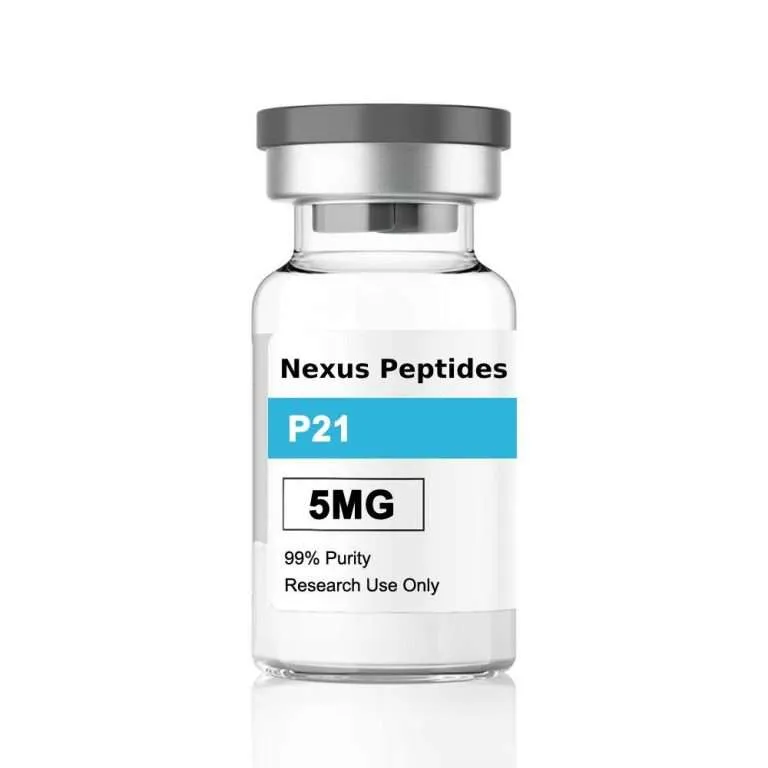
Buy P21: 5-10mg*10 vials
Price range: $130.99 through $230.99
P21 peptide 5–10mg × 10 vials for qualified research and laboratory applications involving neurobiology, peptide science, cellular signaling, and cognitive research.
Description
P21 Peptide 5–10 mg × 10 Vials for Research
P21 peptide is an experimental peptide that has attracted interest in neuroscience and neurobiology research, particularly in discussions surrounding neuronal development, cellular signaling, and mechanisms associated with cognitive and neurological processes.
Our P21 5–10 mg × 10 vials product is intended for qualified laboratory and research applications. It may be relevant to researchers investigating peptide biology, neuronal pathways, cellular processes, molecular signaling, and other experimental areas involving short bioactive peptides.
P21 has generated interest because of research exploring how peptide-based molecules may interact with biological systems involved in neuronal function. However, research interest should not be confused with established clinical efficacy. Claims surrounding experimental peptides should always be evaluated according to the quality, design, and limitations of the available evidence.
What Is P21 Peptide?
P21 is commonly described in research contexts as a peptide associated with experimental neuroscience and cognitive research.
Interest in P21 has developed alongside broader research into peptides that may interact with biological mechanisms involved in neuronal development and function.
Researchers studying P21 may be interested in questions involving:
- Neuronal biology
- Cognitive neuroscience
- Cellular signaling
- Neuroplasticity
- Neuronal development
- Peptide-receptor interactions
- Molecular biology
- Experimental neuroprotection
- Cellular stress
- Brain-related research
Because neuroscience involves highly interconnected biological systems, understanding the molecular behavior of experimental peptides can provide researchers with useful insights into potential mechanisms.
Why Is P21 Interesting in Neuroscience Research?
One of the major reasons P21 attracts scientific interest is its association with research into neuronal processes.
The nervous system depends on highly coordinated communication between neurons, supporting cells, signaling molecules, receptors, and intracellular pathways.
Researchers studying experimental neuroactive peptides can investigate how small peptide sequences interact with these systems.
P21 research may therefore involve questions such as:
- How does a short peptide interact with neuronal cells?
- Which molecular pathways may be affected?
- How might peptide signaling influence cellular responses?
- What role could peptides play in neuronal development?
- How can researchers measure peptide-related changes in experimental models?
- Which findings are supported by laboratory or animal studies?
These questions make P21 an interesting molecule within the broader field of experimental peptide neuroscience.
P21 AND NEUROBIOLOGY RESEARCH
Neurobiology examines the structure and function of the nervous system at molecular, cellular, and systems levels.
Peptides can participate in many aspects of biological communication, including signaling between cells and modulation of cellular processes.
Experimental research involving P21 can therefore be considered within the larger field of peptide-based neuroscience research.
Researchers may investigate:
Neuronal signaling
Studies can examine how experimental molecules interact with signaling pathways involved in neuronal activity.
Cellular responses
Laboratory models can be used to investigate whether experimental peptide exposure is associated with measurable cellular changes.
Neuronal development
Researchers may investigate mechanisms involved in neuronal growth, differentiation, or maturation.
Neuroplasticity
Neuroplasticity refers broadly to the nervous system’s ability to change its structure and function in response to various influences.
Experimental peptide research may examine molecular pathways potentially associated with these processes.
P21 AND COGNITIVE RESEARCH
Cognitive function is influenced by an extremely complex network of biological processes.
Memory, learning, attention, and other cognitive functions involve communication among neurons, changes in synaptic connections, neurotransmitter systems, gene expression, cellular metabolism, and numerous signaling pathways.
This complexity is one reason researchers investigate experimental compounds and peptides in controlled laboratory models.
P21 has attracted interest in this broader research area, but it is important to distinguish between experimental findings and proven human outcomes.
A finding in a cell culture or animal model does not automatically demonstrate that the same effect occurs in humans.
For this reason, responsible P21 research discussions should consider:
- The experimental model
- Study design
- Sample size
- Biological mechanism
- Reproducibility
- Evidence quality
- Translational limitations
P21 AND CELLULAR RESEARCH
Short peptides provide researchers with useful tools for studying molecular biology.
Depending on the experimental design, researchers can examine:
- Cellular signaling
- Protein interactions
- Gene-expression-related pathways
- Cellular stress responses
- Neuronal activity
- Molecular transport
- Peptide stability
- Structure-function relationships
Laboratory methods may include cell-based experiments, molecular assays, microscopy, biochemical analysis, and other techniques appropriate to the research question.
The specific methods used should always be determined by qualified researchers and their established experimental protocols.
P21 AND PEPTIDE SCIENCE
One of the broader questions in peptide research is how a short sequence of amino acids can produce measurable biological interactions.
Researchers can study peptides at multiple levels:
Molecular level
Examining the peptide’s structure, sequence, stability, and molecular interactions.
Cellular level
Studying how cells respond to the peptide under controlled experimental conditions.
Tissue level
Investigating biological effects in appropriate experimental models.
Systems level
Examining how molecular changes may influence larger biological networks.
P21 research fits within this broader scientific framework.
WHAT RESEARCHERS SHOULD CONSIDER WHEN STUDYING P21
When working with an experimental peptide, researchers should carefully consider the quality and characterization of the research material.
Important considerations include:
- Product identity
- Peptide sequence
- Stated quantity
- Purity information
- Analytical characterization
- Batch information
- Packaging
- Storage conditions
- Labeling
- Supplier transparency
Analytical methods such as chromatography and mass spectrometry may be used to characterize peptide materials depending on the research requirements.
For example, HPLC can provide information relevant to chromatographic purity, while mass spectrometry can assist with molecular-mass characterization.
Purity alone, however, does not guarantee that a material is suitable for every experimental application.
P21 5–10 MG × 10 VIALS
The P21 product is available in a 5–10 mg × 10-vial configuration, depending on the selected product option.
A multiple-vial configuration can be convenient for laboratories organizing research materials across different experiments or maintaining individual containers for separate research workflows.
Researchers should follow appropriate laboratory handling and storage procedures and consult the specific product documentation for applicable storage requirements.
P21 RESEARCH APPLICATIONS
Depending on the experimental model, P21 may be relevant to research involving:
- Neuroscience
- Neurobiology
- Cognitive research
- Peptide biology
- Cellular signaling
- Neuronal development
- Molecular biology
- Experimental neuroprotection research
- Neuroplasticity research
- Peptide structure-function studies
- Cellular research
- Experimental brain research
The suitability of P21 for any particular study depends on the research question, experimental model, analytical methods, and applicable laboratory protocols.
HOW TO EVALUATE A P21 RESEARCH PEPTIDE
Researchers purchasing P21 should evaluate more than the product name or advertised quantity.
1. Product identity
The product should clearly identify the research material and stated quantity.
2. Analytical characterization
Where available, analytical documentation can provide useful information about the material.
3. Purity information
Purity data can help researchers evaluate a research material, although purity is only one part of overall product characterization.
4. Packaging
Appropriate packaging can help protect the material during transportation and storage.
5. Labeling
Clear labeling is important for laboratory inventory management and sample identification.
6. Supplier transparency
A responsible supplier should clearly distinguish experimental research materials from approved medical products.
P21 VS OTHER NEUROACTIVE PEPTIDES
P21 is part of a broader field of experimental peptide neuroscience.
Different research peptides may be investigated for different scientific questions.
For example:
| Research Area | Peptide Research Focus |
|---|---|
| Cognitive research | Memory and learning pathways |
| Neurobiology | Neuronal signaling |
| Neuroplasticity | Cellular and synaptic adaptation |
| Molecular biology | Peptide-cell interactions |
| Cellular research | Experimental cellular responses |
| Peptide chemistry | Structure and stability |
Researchers should select an experimental peptide based on the scientific question rather than popularity alone.
THE FUTURE OF P21 RESEARCH
Advances in neuroscience and peptide technology are creating new opportunities for researchers to investigate short bioactive peptides.
Modern technologies including:
- High-resolution imaging
- Mass spectrometry
- Proteomics
- Computational biology
- Molecular modeling
- Cell-based screening
- Artificial intelligence
- Advanced peptide synthesis
can help scientists investigate peptide structure and biological interactions with increasing precision.
Future research may provide additional information about the molecular mechanisms associated with P21 and clarify which observations can be reproduced across different experimental systems.
However, further high-quality research is needed before experimental observations can be translated into established clinical conclusions.
RESEARCH-USE STATEMENT
P21 is discussed on this page as an experimental research peptide.
This product is intended for qualified research and laboratory use only. It is not presented as a drug, dietary supplement, or approved treatment.
Nothing on this page should be interpreted as medical advice, a diagnosis, or a recommendation to use P21 for treating, preventing, or curing any medical condition.
Researchers should comply with applicable laboratory procedures, institutional requirements, and relevant regulations.
FREQUENTLY ASKED QUESTIONS
What is P21 peptide?
P21 is an experimental peptide that has attracted interest in research involving neuroscience, neurobiology, neuronal processes, and cellular signaling.
What is P21 studied for?
Research interest includes experimental investigations involving neuronal biology, cognitive processes, cellular signaling, and related molecular pathways.
Is P21 a research peptide?
Yes. P21 is discussed primarily in the context of experimental peptide and neuroscience research rather than as an established medical treatment.
Is P21 approved as a medicine?
P21 should not be represented as an approved treatment for a medical condition. Researchers should consult the relevant regulatory authorities for current jurisdiction-specific information.
Why are researchers interested in P21?
Researchers are interested in P21 because short peptides can provide experimental models for investigating molecular signaling and neuronal processes.
What does 5–10mg × 10 vials mean?
It describes a product configuration containing ten individual vials, with the selected option containing either 5 mg or 10 mg per vial.
What should researchers look for when purchasing P21?
Important considerations include product identity, stated quantity, analytical information, purity data, labeling, packaging, storage information, and supplier transparency.
Is P21 intended for human use?
This product is presented for qualified research and laboratory use and should not be represented as a human-use therapeutic product.
Additional information
| Quantity | 5mg * 10vials, 10mg * 10vials |
|---|
Related products
-

FOXO4-DRI (Proxofim) 10mg*10 vials
$1,279.99 Add to cart -
Humanin: 5-10mg*10 vials
Price range: $180.99 through $320.00 Select options This product has multiple variants. The options may be chosen on the product page -
Buy Kisspeptin: 5-10mg*10 vials
Price range: $130.99 through $230.99 Select options This product has multiple variants. The options may be chosen on the product page -
Bacteriostatic Water: 3ml*10 vials (30ml)
$22.00 Add to cart
Reviews
There are no reviews yet.